GEstimator
Website • Forum • Bug tracker • Git repository




GEstimator prepares cost and quantity estimates of civil and electrical works with detailed rate analysis. It comes bundled with DSR 2023 (Civil), DSR (E&M) 2025 and DSR 2025 Horticulture, and works with any number of your own databases.
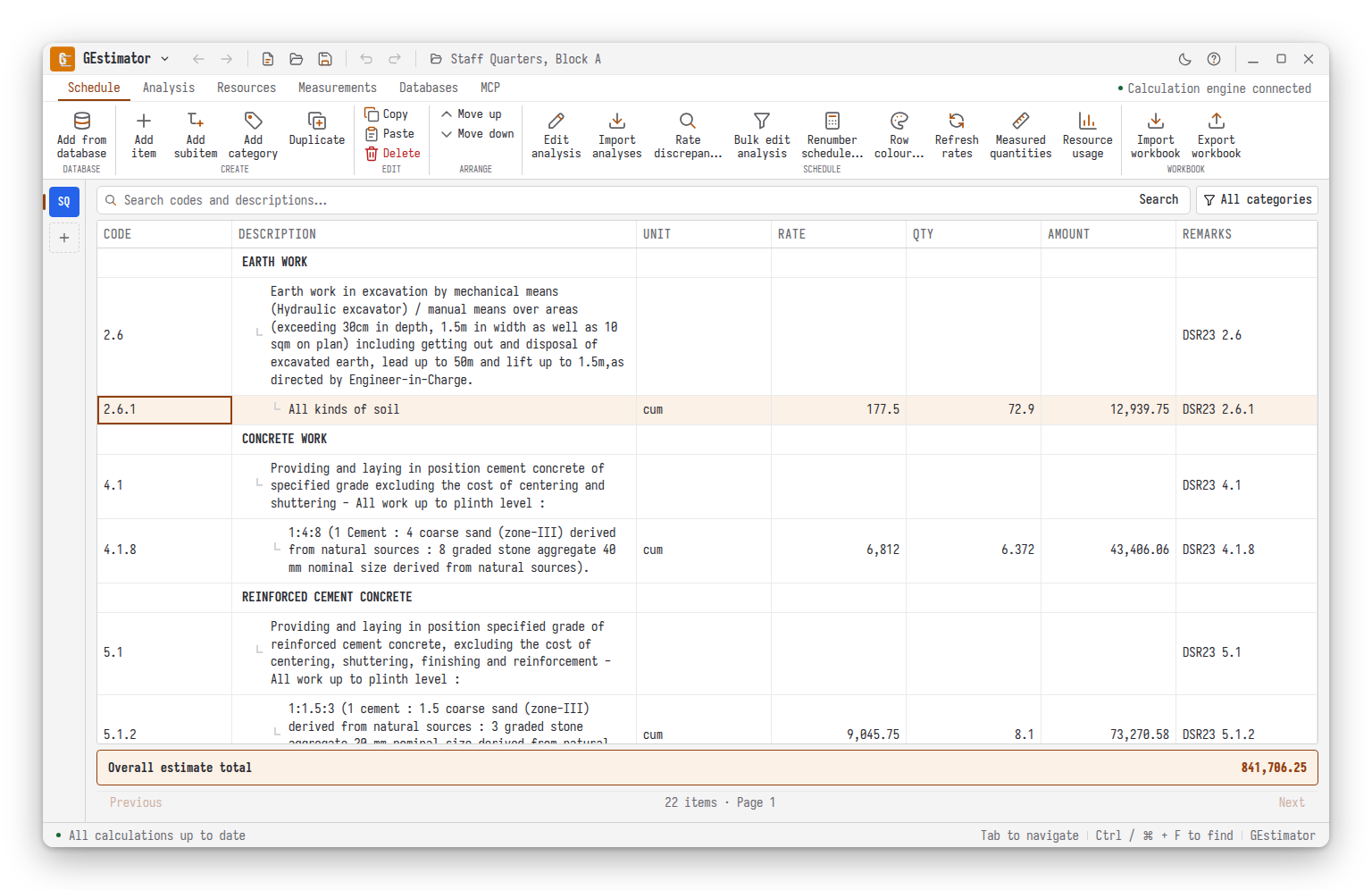
Features
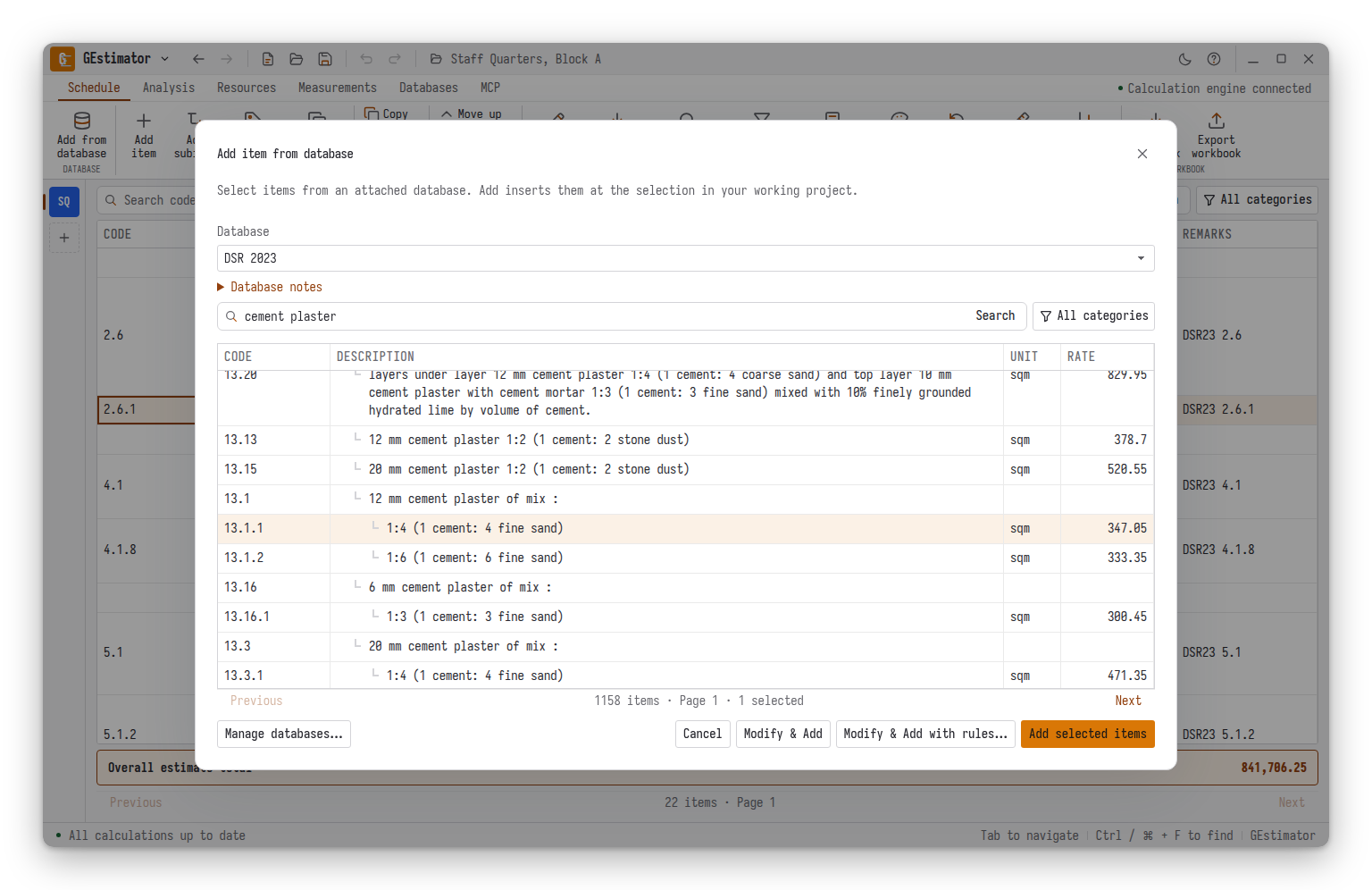
- Schedule of estimate items, added from a database, entered directly or imported from a
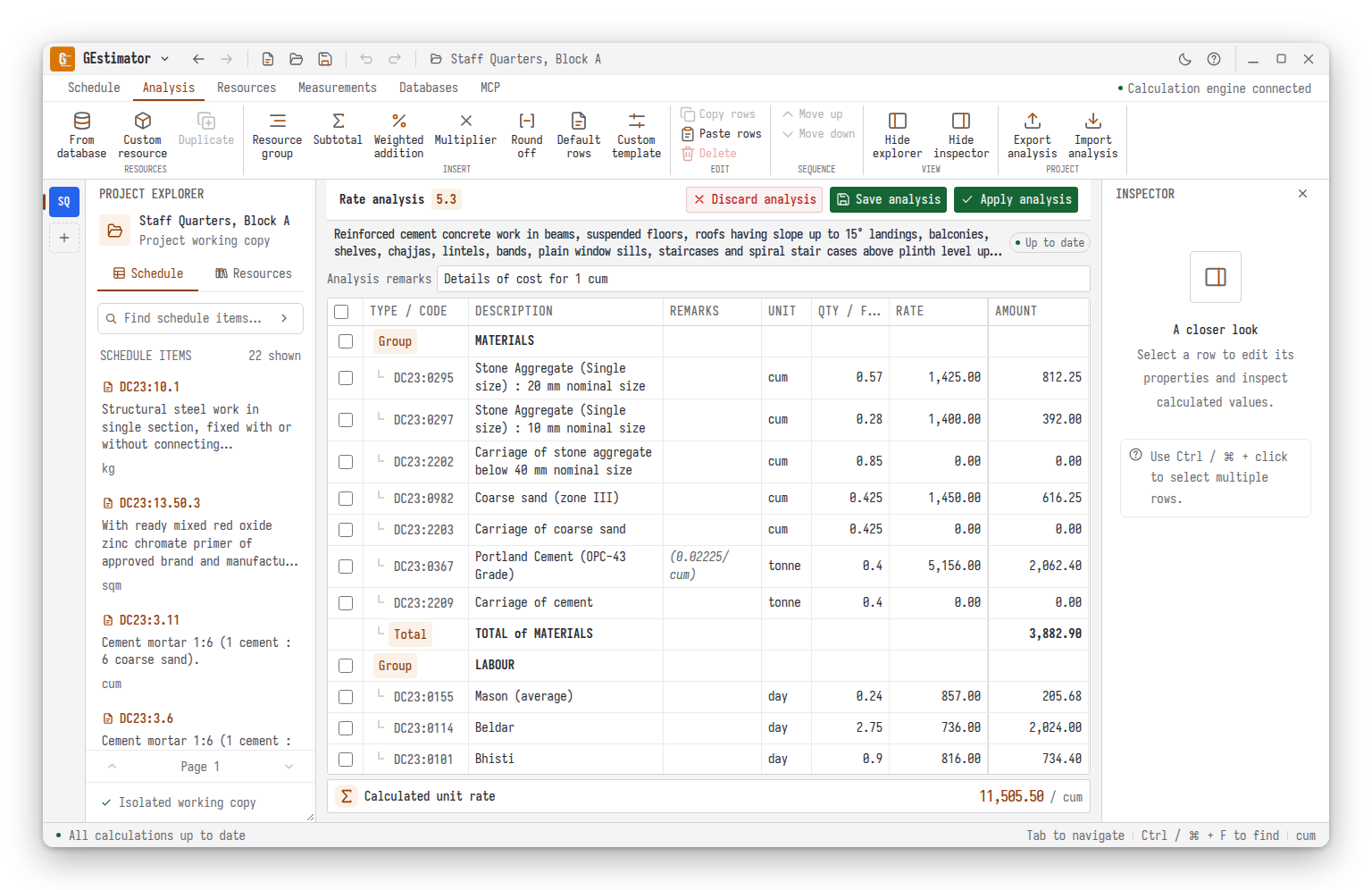
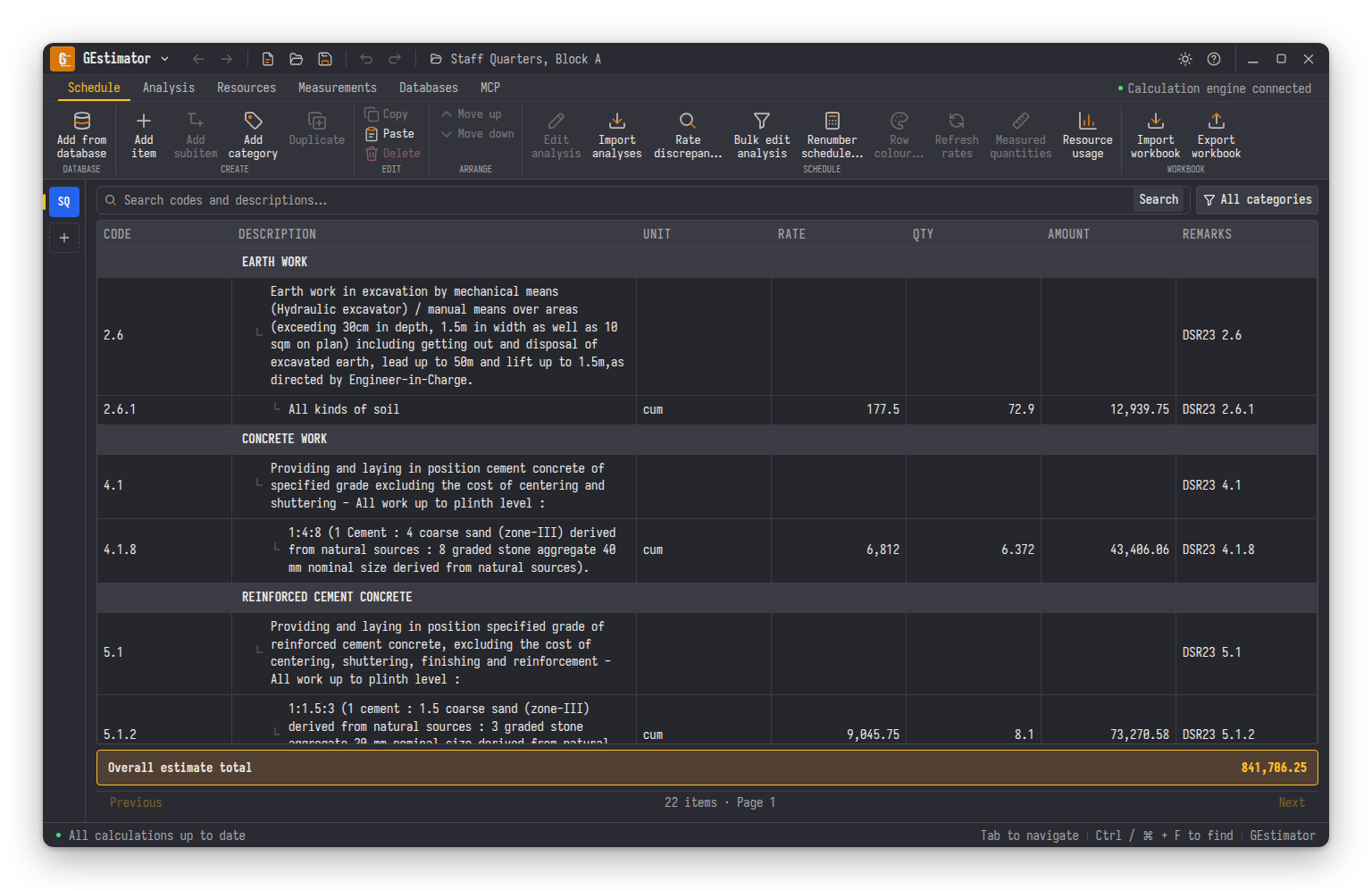
.xlsxworkbook. Items keep their rate analysis, so every rate stays traceable. - Rate analysis editor with resource groups, subtotals, weighted additions (CP&OH, GST, cess), multipliers and rounding. Changing a resource rate updates every dependent item. Bulk edit rules change many analyses at once with a preview.
- Resources (materials, labour, plant) shared by all analyses, with usage reports and rate refresh from a newer database.
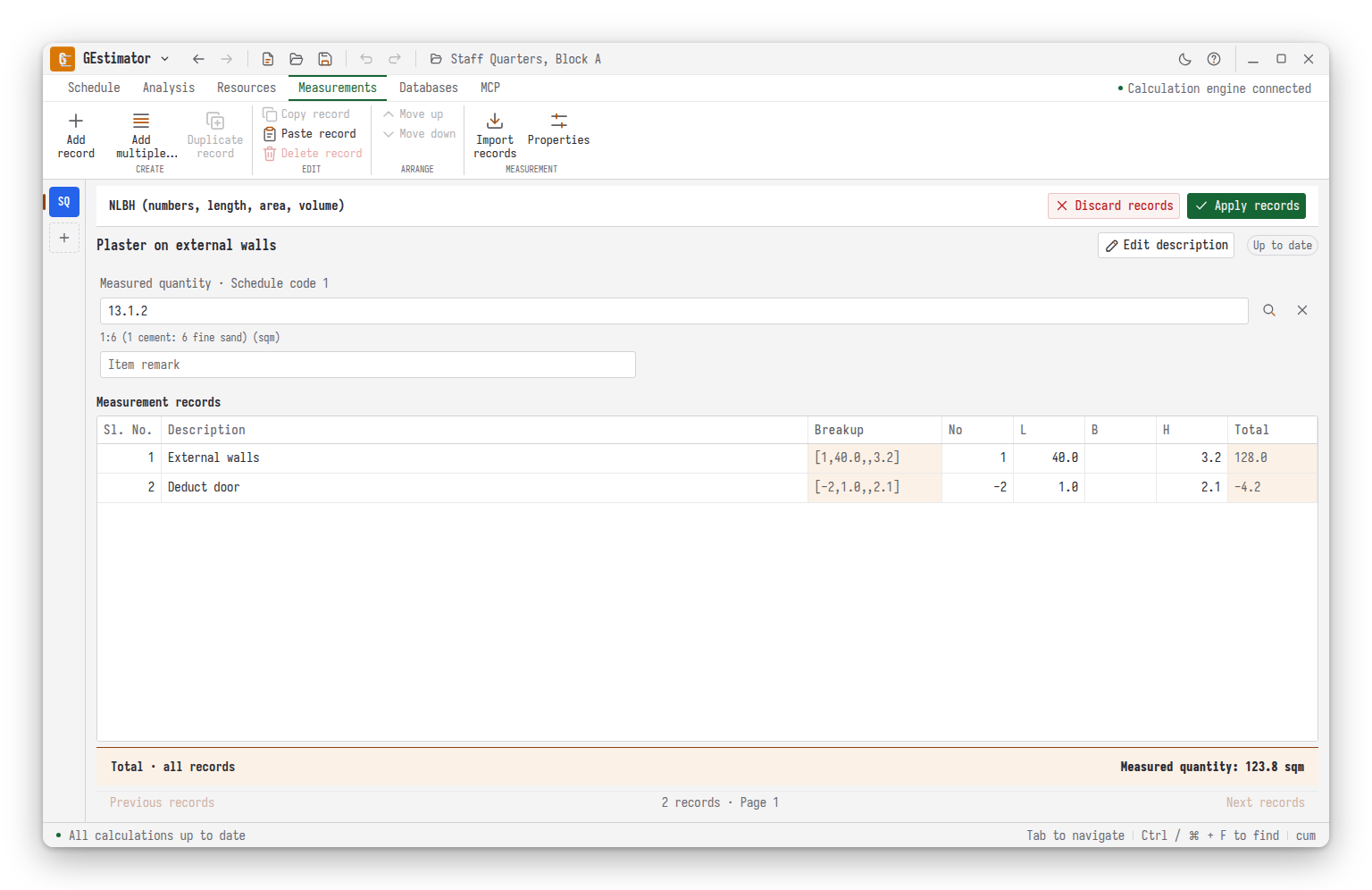
- Measurements recorded against schedule items with templates (NLBH, steel reinforcement, electrical points, ducting), expressions in cells and automatic quantity update.
- Databases attached read-only, with notes on how each is organised and what its rates include.
- Export of the whole estimate to a
.xlsxworkbook: schedule of rates, schedule of resources, details of measurements, resource usage and analysis of rates. - Several projects in tabs, undo/redo, light and dark themes, and recovery of unsaved work after a crash.
- AI assistants (optional): a local MCP server lets Claude or any MCP client read and prepare estimates in the open project.
User manual
The user manual walks through the whole workflow with screenshots, using a sample estimate priced from DSR 2023.
 |
 |
 |
 |
Databases
DSR 2023 (Civil), DSR (E&M) 2025 and DSR 2025 Horticulture are bundled. Older schedules and other databases (DSR 2016–2021, DSR (E&M) 2016–2022, market rate databases) can be downloaded from Other databases. Any GEstimator project (.eproj) can be attached as a database.
Installation
Installers for Windows (.exe) and Linux (.deb, .AppImage, Flatpak and Snap) are published under Releases.
On Windows, uninstall any 2.x version of GEstimator (Settings → Apps) before installing 3.0. The new installer does not remove it.
Version 2.7, the last release of the earlier GTK application, remains available under Releases; its source is on the archive/gtk branch.
Building from source
The application is a Tauri desktop program (modern/) with a Vue interface and a Python backend (modern/backend, using the calculation engine in estimator/). Start with the documentation index for development, architecture and code-quality guidance. modern/README.md owns prerequisites and platform build commands.
Release packages are built by the Release workflow on a version tag. The Flatpak builds from source (packaging/flathub, the manifest used by Flathub); the Snap (snapcraft.yaml) repackages the Linux .deb.
For contributions, follow AGENTS.md, the documentation reading order, development workflow and repository quality audit. Current database, backend, frontend and MCP contracts link to their source and regression tests. The Code quality workflow checks changed-file formatting, documentation links, backend tests, frontend builds, browser workflows and native Rust code.